Sunday, June 7, 2015

Google and its services

You know what a browser it, right?  It is the program you open to get to the Google Search page.  There are many browsers but on computers, here are the four big ones:

Firefox

161

(53%)

Chrome

59

(19%)

Internet Explorer

51

(16%)

Safari

23

(7%)

This is the breakdown of browsers used recently to view my blog on its web page fearfunandflioz  Firefox is an independent browser, Chrome is Google's own, Internet Explorer with its iconic blue e is Microsoft's and Safari is the Apple browser.  Some Amazon products have a browser called Silk.


All of these program do roughly the same thing, browse the internet, get you to web sites, whether it is the Weather Channel or Netflix or the Kirby variety one.


One of the best things I have done for myself in computing is to use both Gmail, Google's email program and to tell Google's browser, Chrome, that I wanted to sync.  That means, whether I use a computer, my iPad or some other computer. Chrome has my bookmarks ready to go in the same form and the same order wherever I am.  That way, I doesn't matter whether I am using a Windows machine or an Apple or something else.


All browsers have the ability to import a set of bookmarks and export a set.  So, if I have the ones I like for convenience in one browser, I find the place in that program to export the bookmarks I have made (Internet Explorer calls them "favorites") and say I want them exported.  I usually tell all my browser to export anything to the desktop, a good place for me to see files I have downloaded. Then, I tell any new browser to import the file that I just exported.  


I use Google to search, Google's Gmail for email, Google's Blogger for my blog and Google's Sites for my web site.  All available all the time, everywhere I am connected and all free.  Thanks, Google!


--
Bill
Main blog: Fear, Fun and Filoz
Main web site: Kirbyvariety


Friday, December 17, 2010

Microsoft's Browser ??!?

I have been a fan of the free, open source browser Firefox for several years.  The thing I like most about it is its option to delete all cookies when I close it.  But, as with all things human and even more so, with all things modern tech, computer and internet, things change.  I saw several articles by that sharp reporter for the Wall Street Journal on how cookies are changing to similar things that are harder to detect.  So, a single pixel in this file might be some sort of code that tracks your activities and tells me that I can possibly sell you shoes or books or insurance.  Since cookies and the marketing of possible customers is changing, maybe the setting on Firefox that I like isn't as important anymore.  

Google's browser "Chrome"
also seems to be a good one.  The Microsoft browser "Internet Explorer", the well-known blue 'e', comes as part of the Windows operating system and is or was an important part of keeping the system updated and secure.  

I was quite surprised when
several items in this morning's Google news reported an independent test of browsers which resulted in showing that Internet Explorer was far better at detecting and warning the user of "socially engineered" threats.  That term seems to mean attempts at wording a page or other communication in such a way as to tempt the user to click here when doing so is not in the user's best interest.  Each time we "visit" a web site, we are actually permitting a file to enter the browser on our machine and show the layout, wording, pictures, sounds, etc. that are built into the coding for that "page".  So, characteristics of the browser are quite important in getting us around  the internet safely and without irritating or costly complications.  The current version is IE8 but the beta form of IE9 was even better, much better than the main competitors.

IE 9 is only in beta form but it detected 99% of the test threats while IE 8 detected 90%.  Compare that to 19% for Firefox, 6% for Chrome and even worse for some other major browsers.  

Of course, these things don't come out of the sky and Microsoft, Google and Apple are engaged in a mighty struggle for the internet accessed through computers and cellphones.  I haven't looked into the test results or the characteristics I think I most want in a browser but I may give the IE9 a try. 

Wednesday, November 7, 2018

Other interesting finds on the internet

I habitually use two browsers, Google's Chrome and the Firefox browser.  Firefox is supposed to be somewhat independent and is related to Mozilla, the organization behind the first browser I used to roam the worldwide web.  That one was called Netscape.


The browser that comes with Windows was called Internet Explorer and was symbolized with a blue lowercase e.  Now it is symbolized with a similar lowercase (not a capital letter) but the e has a modern "haircut" that supposedly gives it a jaunty look.  I also use the browser that comes with Apple products once in a while, "Safari" and I use another browser "Opera" sometimes. I am far from an expert in browsing programs but generally I like Firefox.  I open Chrome everyday and I use Google email (gmail) and websites (Sites) and my blog Fear, Fun and Filoz is housed in Google's blogging service, called Blogger.


Firefox still has many good things about it and I use it every day.  Of the browsers I have mentioned here, it is the only one to house "Pocket" on its new page page.  That's the page that comes up when you click the plus sign in the top line of the window on the right hand edge of the tabs that are open.  The other browsers put the sites the user often clicks on or searches for on that new page page and so does Firefox. But it also has Pocket, which tries to search out content and other web pages that the user, given where he has been, might like.  I have been impressed at the quality and imagination of the finds Pocket has suggested to me.


Here is a page on my own web site of some recent suggestions Pocket has given me:

https://sites.google.com/site/kirbyvariety/-pocket-finds


The links are live and the articles are actual items on the web.

Sunday, February 5, 2023

Whatever you are thinking

I have been following a routine that I like.  It is putting phrases, questions, subjects into Google.  I use Firefox browser and I have my computer set to default to Duckduckgo for searching.  Both Microsoft and Google remind me in various ways that they prefer that I use Edge and Chrome but I don't want to and I don't.  I wouldn't approve of a single store building the only entrance from the mall parking lot to their store, even if I could leave their store and go to others.  The first browser I used was Netscape and I have read that Marc Andreessen was an important part of the development of software that could be used to visit "web sites" that had "web addresses."  Andreessen is still part of computing and the Foxfire browser reflects the idea that the user should be assisted, not herded.


I still find Google search the most powerful and complete.  I have actually never had any typical search that I followed up all the results of the search.  Beyond the first page or two of search results, I don't usually have any desire to go.  Everything I see says that Chrome is the most used browser. It can be surprising to search "browsers" or "search engines".  Usually the result is longer than I thought it would be and includes names and possibilities I never heard of.  


What I like about using Google search is the extra that the software adds.  That extra includes items, ideas and sources I never thought of.  Each time I enter a search word or phrase, I get results I haven't considered.  Sure, a good many of them are of no interest but some of the related questions that people have asked spark my thinking in new directions.  I enjoyed fooling with "Eliza", software that more or less acts like a counselor.  I might enjoy the new bot that is getting lots of attention: ChatGPT.  It is supposed to be very smart and capable.  But I may well get to the end of my life before I feel I have exhausted the usefulness of Google Search. 

Wednesday, March 3, 2010

Computer tools online

In using a computer these days, the browser is an important tool.  It's the program that receives files from across the internet and opens them as "web pages" from all those valuable web sites, such as Google's main page, Google News, the British Broadcasting Corporation, and your favorite sports team or knitting circle.  For instance, wherever we go, I find that Zap2it gives a useful list of tv programs and times for that location. I have been an advocate of Firefox as a good free browser and it is indeed very good.  However, it seems to me that the browser offered by Google, called Chrome, is nearly as good in some ways and better in others.  Both browsers are said to be superior to Internet Explorer, the browser that comes with Windows and both are written to have security.  But, in using multiple computers or limited computers, speed counts.  It may be that Chrome actually takes up more of my computer than Firefox does but it seems faster at loading itself into working memory.  

Firefox can be easily set to stay in the mode that leaves little or no trace behind when visiting web sites and once set, it stays that way from session to session.  It is a little more trouble to use Chrome in that way but it can be done.  In both browsers, it is easy to look at the Options and see what tracking cookies have been left behind and remove them. (Update: just today, I found that Chrome 4.1.2, a beta release, has more permanent settings that give it about the same privacy abilities as Firefox.)

I have gotten to like Chrome since it keeps track of my favorites and gets me into them quickly.  It opens a new tab very quickly, too.  At the moment, I have 7 tabs (separate windows of different sites) open.  If something comes into my Gmail, I can see that is has and switch over to Google's free email quickly and conveniently.  Chrome has many other features that I am not really familiar with but I may get to over time.

Thursday, August 29, 2013

Cookies

We have two kinds of cookies for lunch, cheap and expensive.  The cheap all come from Wal-Mart, the closest grocery store to our house.  Some are varieties of Pepperidge Farm, some World Table Chocolate Caramel, some Walkers shortbread cookies from Scotland and some strawberry or lemon filled Henry Lambertz cookies from Germany.  They are the ones we trot out on alternate days.


On the other days, we split one expensive cookie ($2.25 each) between us.  The cookies, called Nuts2Chew, are hefty and filled with nuts, raisins and craisins.  These cookies come from the hardworking Earth Crust bakers, inside our local food coop.  We end most of our lunches with cookies and fruit of one sort or another.


There are  the third kind of cookies in our lives, too.  Those are the small bits of code that various companies leave on our computers, to track our browsing.  These were originally created to make signing into an account easier and faster.  Most browsers can be set to retain these "cookies" indefinitely or just for that session of browsing the web or to not accept them at all.  I am not a fan of being tracked, although I understand it is pretty difficult to avoid.  Some commentators on the National Security Administration (NSA) surveillance of private citizens have pointed out that tracking companies that collect data about my favorite sites on the web know a great deal more about my typical online behavior than the NSA does, unless, I suppose, I come under special scrutiny.


When you stop to think how the World Wide Web works, you grasp the fact that every time you click on a link, in the results of a Google search or on your church's website or anywhere, you are actually sending a request for a "file" to be sent to your computer.  It is the file that will make the "web page" appear as it was laid out in the browser that you are using.  This means, of course, that the server sending the file must be given the computer's address.  It needs to know where you are if it is going to send you something.


I often start my computing day using Chrome, Google's browser, since it is touted as especially fast at loading and being ready to use.  For a while, I didn't understand why I should "sign in" to use a browser.  However, eventually, I understood that Google will preserve my bookmarks and lots of other stuff (most of which I don't want kept but I do get to pick and choose.)  Most computers anywhere have Chrome on them (since it is free and unobtrusive) and can serve as a handy alternative to Internet Explorer (the blue "e") or Safari on Apple products.  But, once I agree to let Chrome save my bookmarks, they are available on any computer and that can be handy, especially for the way I use my iPad.  After my computer is more or less warmed up and fully loaded, I usually close Chrome and switch to my main browser, Firefox.


--
Bill
Main blog: Fear, Fun and Filoz
Main web site: Kirbyvariety


Wednesday, December 16, 2020

Browsing around the world from your desk

In the Windows operating system for a computer, there is a browser that is part of the software.  It is now called Edge but it used to be called Windows Explorer.  It used to be represented by a blue lowercase e, then the e got an edgy snip in the top and now it is represented by a blue swirl or wave. A browser is a computer program that enables a user to jump around the world to various websites.  You may have read that scientists started sending data to each other and Sir Timothy Berners-Lee, working at the Bern, Switzerland atomic energy center, saw the possibility of inventing what we generally call "web addresses" and allowing communication much like email.  


The address window in a browser is where we type in the web address we want to reach.  For instance, the world wide web address for the "page" of this blog is https://fearfunandfiloz.blogspot.com/  The "address" is also referred to as a "URL", universal resource locator.  The first browser we used was Netscape Navigator but when we began using the web, many of the organizations and possible destinations we were interested in didn't have web addresses at all.  Then, ads and groups began to acquire an internet presence.  


Just as it takes a while to find out what some of the possibilities with a smartphone are, it takes a while to learn your way around any set of mechanical options.  You can investigate Google Blogs or Wordpress or Google Sites to start writing for people all over the world or post pictures for them of your garden. That would develop your own URLs.

Thursday, May 13, 2021

Terms, conditions and intrusions

Many of my friends have Google email addresses.  I keep stressing that anyone with a connected device, like a smartphone, tablet or computer can easily get themselves a Gmail address.  One reason for doing that is to take advantage of what comes with a Gmail account, which is free.  On the basic Gmail page is a small 3x3 set of dots in the upper right corner.  That set of dots is the Google app launcher and it includes many programs and applications that can be used with a Google name and password that is used to get Gmail.  


If you browse to Blogger.com, you can start a blog, a site where you can write or post pictures that interest you or your friends.  If you browse to sites.google.com, you can start your own web site or just search "start Google website".  


When you use Google products and services and many other things on the internet, you will often find that you can't proceed without agreeing to the terms and conditions set for that product or service.  Some sites allow a user to proceed only if they check that they agree.  Some sites will only allow a user to proceed if the multiple pages of rules and conditions have been scrolled through.  I usually scroll through far more rapidly than I can read the words involved.  When I have tried slowing down and reading the words, I find many terms that I don't understand and many others that I probably don't understand.


When I visit various web addresses (a.k.a. "URL"s - universal resource locator, you can see why they wind up getting called web address), I get interrupted.  Usually rudely, impolitely and incessantly.  It seems a little dumb to write something and post it for readers all around the world to read it and then jam something else across the writing.  This something else is either politely or impolitely written, and it can be quite intrusive and insistent.  I get asked to state my email address and open an account so that the owners of this site can pester me and further overburden me with emails, pictures and the very greatest products hawked by the most attractive models in the world, or so they would have me believe.


The world's most popular browser for jumping around the internet is the Google browser Chrome.  ⅔ of internet users use that browser worldwide. 2nd most popular is the Apple browser Safari, used by about 20%.  I use Firefox as do about 3.5% of internet users.  Firefox is not Microsoft, Google or Apple or Amazon.  Its Pocket service is handy for avoiding some intrusions but not all.

Monday, May 21, 2012

Google Chrome and Chrome apps

Many of my friends dislike Wal-Mart but I read "The Wal-Mart Effect" by Charles Fishman and came away thinking the company does many good things.  Besides, that store is closer to my house than any other and it saves expensive gas to shop there.  Similarly, many of my computer friends don't like Google: too powerful, too sneaky, too likely to record everything I do.

Again, I feel differently.  Google has provided me with several blogs and more than 1000 free blog posts.  I use its email "Gmail" many times a day.  Of course, I use the Google search engine all the time and have pounded into my head the idea that every puzzle and difficulty should be checked in Google Search to see what comes up.  Quite often, my puzzle is solved after reading just a few of the entries.  I like the Firefox browser and use it as my main one, even though the Microsoft browser, Internet Explorer (the blue "e") has gotten steadily good reviews about its security and usefulness.  

I realize that with Google Docs (now Google Drive) and its free word-processing, spreadsheets and drawing, I need the usual parts and programs on a computer rarely.  However, since Google operates on web pages, it made sense for Google to create its own browser, called Chrome.  I don't know much about just what a browser actually does but I can see that the options available are contingent on how the program was written.

With the advent of cloud drives, where my files are saved somewhere out in "the clouds" of the internet and the related web-based tools such as Google Docs, what is actually needed on a computer to do what I want is quite minimal.  Google realized that and has the new sort of computer called a "Chromebook".  The hugely successful iPad is a similar device in that it doesn't need much memory, although there are probably important differences for the user between the Google design and the Apple design.

Chromebooks are run by the "Android" operating system, a version of which runs many smartphones.  Making use of the open or semi-open approach that resulted in hundreds of thousands of extensions and little program additions and modifications called "apps" (from "application", a common word for what I learned to call a program), Google-Android also has apps.  Looking through the app store for both Firefox and Chrome, I looked for something that might actually enhance what I want from my computing.

I found "Google Similar Pages", which is free and in "beta" or still-experimental form.  I used that app to go to the page of each of the blogs I follow on my main blog page and let Google Similar Pages find similar pages.  Sometimes it couldn't find any similar pages but I found and bookmarked several, too many actually to pay steady attention to but still of interest.  Here is a web page of the links I found interesting:

http://sites.google.com/site/kirbyvariety/google-similar-pages-found


--
Bill
Main blog: Fear, Fun and Filoz
Main web site: Kirbyvariety


Friday, December 3, 2021

Many good tools

Friends tell me that Google will sell my name and "contact information", resulting in a deluge and a half of unwanted messages, notifications and offers.  That may be happening but so far, it isn't too bad.  I read just today of a politician trying to amass a treasure chest to pay for publicity whose campaign made more money selling contact information gleaned from donors than in direct donations.  I don't know enough about modern computers and internet communications to know why the big companies and small ones all want me to use their browser, the program that takes me browsing around the internet.  I have Microsoft's Edge, Mozilla's Firefox, Opera and Vivaldi on my computer. I rarely use Google's Chrome.  I do use Chrome once in a while.


I have heard of Duckduckgo for searching the internet and finding web addresses, a.k.a. URL's (universal resource locator).  So, I told my go-to browser, Firefox, to use Duckduckgo for searches.  More than 20 years ago, I used Lycos, the best internet searcher software I could find at the time.  Lately, with my browser set to use Duckduckgo, I have been finding that Google has a better design and better results.  That may be because I am used to the Google layout but I am finding more of what I want going to Google.com


My nephew has a degree in computing and when I say that he used Gmail, I did, too.  When you use Gmail, there is a handy "app launcher" on the web page that can lead you to the many, many Google products and services.


I have inserted a thin red line in the upper right corner of the image.  I urge exploration of the little 3x3 set of white dots.  There are many excellent tools there.

Thursday, April 17, 2014

chat and video chat

I am confident there are many ways to chat online.  I use Google Gmail chat once in a while.  If you and a friend both have Gmail accounts, which are free and fairly free of pesky offers, you can both install Chrome, the Google browser.  It may be that using chat in that browser is a little easier than in the blue e Internet Browser or the Mac's Safari.


In Gmail on the lower left, there are a set of buttons relating to chat and who among your contacts might be online and interested in chat. Despite the name, chat is often silent but immediate exchange of short messages, not unlike texting. With Google Gmail chat, you can speak and you can see each other, free and over the internet.  I haven't used Skype or any competing product for speaking or seeing over the internet but Google chat uses the internet and has no special charge associated with it.


The service is very much like Apple's "Facetime".


I am not clear about whether someone with a non-Google email address (not Gmail) can chat with a Gmail user.  I think one of the chaters needs to be in Gmail to get it started.


Recently, Google added its Hangout service which allows video/audio calls among up to 9 callers at the same time.  For some meetings and committees, that might be very handy and helpful.  Of course, not everyone wants to be seen and may prefer to just listen and speak but not be on video.


--
Bill
Main blog: Fear, Fun and Filoz
Main web site: Kirbyvariety


Thursday, April 21, 2022

Getting the news

My friends complained they don't like the news they get.  I am not referring to news content as much as style and criteria as to what to include in reports.  


My wife and I get zero news from broadcast tv or radio.  Well, NPR might be an exception for Lynn and she has an online subscription to the New York Times.  We are both rather regular readers of the online CNN Five Things.  


I look at Five Things, Numlock News, Google News, Writer's Almanac. I highly recommend using the Firefox browser.  It isn't a product of any of the big tech companies and there is not a push to expand the use of other products.  I am a big fan of the GetPocket service.  It is part of the Firefox browser and it is free.  Whenever I go to New Page to open an additional tab in my browser, Firefox and Pocket present snippets of a wide array of articles that might be of interest. Firefox also has a button that can strip out ads, inserts, and other distractions from webpages.  It is referred to as "Reader view" and it can help. 


The language of a headline or title can set the tone of the item. "Worst disaster in a decade" vs. "Fire in lumberyard" can make a big difference.  I realize that writers are trying to get readers and reactions but I still go for a calm approach. 

Saturday, March 11, 2017

Fwd: The Scout Report -- Volume 23, Number 10

The bottom of the Internet Scout Report is probably truncated and you may be able to expand it.  Several items in this edition may be of interest.  You can get your own copy every other Friday by signing up.  Put "Internet Scout" in Google or Bing or Duckduckgo and go to the site.  The tools section at the end mentions "Ghost Browser" and "Pixabay", tools which address the need or use of multiple browsers to keep open multiple sites like social ones (Facebook, Twitter) and search for and use of images and video clips for presentations and such.  

Bill
---------- Forwarded message ----------
From: scout@scout.wisc.edu <scout@scout.wisc.edu>
Date: Fri, Mar 10, 2017 at 11:21 AM
Subject: The Scout Report -- Volume 23, Number 10


March 10, 2017
Volume 23, Number 10

Research and Education

General Interest

Network Tools

In the News

If you would like to make a tax-deductible contribution to support The Scout Report and the work of Internet Scout, please visit our donation page.

Research and Education

Back to Top

Mapping the Overland Trails
Social studies
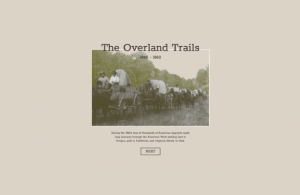
The Overland Trails, 1840-1860 is one of five maps from American Panorama, a historical atlas project from the Digital Scholarship Lab at the University of Richmond. This specific map traces the experiences of about two dozen American migrants who moved westward during the mid-nineteenth century. Over 2,000 diary entries have been transcribed and organized onto a map according to route (e.g. the Oregon Trail, California Trail, and Mormon Trail). Once visitors select a route, they can examine a list of individuals who kept track of their daily lives while traveling west. In addition, the map provides information about significant historical and political events that occurred concurrently with each diary entry. Mapping the Overlands Trails provides visitors with a way to examine primary documents in context, offering an engaging resource for history classrooms. [MMB]

From Psychology to Logic: Learning Computer Programing in the Kitchen
Science
From MIT BLOSSOMS, a video series dedicated to high school mathematics and science instruction, comes this innovative lesson that engages students with computer programing through a series of hands-on activities. In this particular video lesson, Tanzeena Ali, a computer science student at Superior University in Pakistan, presents a series of problem solving activities centered around the simple task of making a mango milkshake. Throughout this presentation, Ali poses a series of questions that high school students would be able to answer quickly: How do I determine which mango in the bowl has the greatest mass? How do I arrange my jars from tallest to shortest? As students work collaboratively to solve this problem, their challenge is to represent their problem solving strategy in a way that a computer program could understand. Through each task, Ali demonstrates programming skills and concepts including variable swapping, sorting an array, and finding the max of an array. The lesson that Ali models in the video is aimed at "those students who know the syntax of programming in any language (C or GWBASIC preferred), but are unable to build the logic for a program." This video lesson is accompanied by a teacher's guide for those who may want to adapt the lesson to better fit the needs of their classroom. [MMB]

The Collected Poems of Gavin Turnbull Online
Language Arts
Born in Scotland in 1765, Gavin Turnbull, a contemporary of Robert Burns, worked as an actor and published two books of poetry before he immigrated to Charleston, South Carolina in 1795. In 1840, poetry scholar James Paterson lamented, "Of the subsequent history of Turnbull we are almost entirely ignorant." Fortunately, more recent English scholars have uncovered more information about Turnbull's life in the United States, revealing his subsequent work in both poetry and theatre. On this website, visitors can read poetry that Turnbull penned on both sides of the Atlantic and learn more about this influential but oft-overlooked writer. These poems include work from his most famous publication, 1788's Poetical Essay, along with recently uncovered poems that Turnbull authored in Charleston (and often published individually in local newspapers). Through this collection, literary scholars and poetry fans alike can explore the characteristics and development of Turnbull's poetry. [MMB]

Teaching Calculus
Mathematics
Lin McMullen is a former high school calculus teacher who has fifteen years of experience working with high school calculus teachers to help them improve their craft. McMullen has also created this resource website for calculus teachers and students alike. Teaching Calculus can be browsed in a number of ways. Those who are currently teaching or taking a Calculus class can explore Thru the Year, which organizes calculus resources in the order in which they are typically taught in American high schools. For example, visitors will find resources related to Theorems, Definitions, and Logic in August followed by Computing Derivatives in September. Resources include study guides, definitions of key terms, classroom activities, and instructional videos. These videos are also available for browsing in the Video section of the website. Collectively the Thru the Year and Video section provide useful resources for instructors to incorporate into their classroom or for students to use while working on homework. In addition, instructors can find a variety of PowerPoint presentations and handouts in the Resources section. [MMB]

The Glossary of Education Reform
Social studies
What is a norm-referenced test? What does it mean for a student to be "college-ready"? What does project-based learning entail? Designed for "journalists, parents, and community members," the Glossary of Education Reform is intended to make jargon and terminology used in educational policy circles accessible to anyone. While vocabulary related to educational reform is often linked to particular policy implementations and ideologies, the team behind the Glossary of Education Reform strives to be as objective as possible. The Glossary was created by the Great Schools Partnership, a Portland, Maine based non-profit organization that works "to redesign public education and improve learning for all students." This resource is authored and edited by a team of educational policy analysts, journalists, and scholars. Users can search for terms or browse terms alphabetically. [MMB]

EdX: The Extremes of Life: Microbes and their Diversity
Science
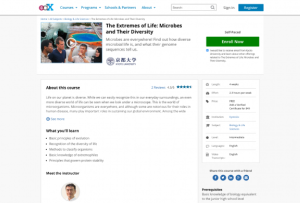
Kyoto University offers this open EdX course dedicated to microorganisms and their role in our world. More specifically, this course investigates microbes that are able to survive in extreme environments and temperatures. As the course introduction explains, "Microorganisms are everywhere, and although some are notorious for their roles in human disease, many play important roles in sustaining our global environment." In this course, anyone can learn more about microbes via video lectures, course readings, and assignments. These materials are divided into four units: Evolution and the Diversity of Life; Life in Boiling Water; Diversity of Extremophiles; and Genome Sequences. Intended for anyone with a middle-school level knowledge of science, this course is self-paced but designed to be completed in about four weeks. Auditing The Extremes of Life is free; students also have the the option to earn a certificate if they pay a course fee. [MMB]

The Milton and Nelma Fillius Jazz Archive
Arts
For music scholars as well as music fans, the Milton and Nelma Fillius Jazz Archive, part of Hamilton College Library's Digital Collections, will appeal. The archive is split into two kinds of resources: interviews and photographs. In the first section, visitors can browse over 300 interviews conducted by composer (and Fillius Jazz Archive Coordinator) Monk Rowe and Hamilton professor Michael Woods. Each interview record includes a full transcript of the interview, accompanied by an audio recording of the interview and a photograph. Interviewees include Be'la Fleck, Herbie Hancock, and Etta Jones, to name just a few. Visitors to this archive can also search for interviews by Topics (e.g. composers, saxophonists, music educators) or Subject Headings (e.g. Jazz festivals, Sound recording industry, Ragtime Music) or by conducting a text search of interview transcripts. Meanwhile, in the Photographs section, visitors can explore hundreds of jazz musicians and bands. [MMB]

Atlas of ReUrbanism
Social studies
The Preservation Green Lab at the National Trust for Historic Preservation aims to connect historic preservation with growing interest in sustainability nation-wide. With this goal, the organization has created the Atlas of ReUrbanism, a series of interactive maps that present data about urban buildings in an engaging fashion. Aimed at urban developers, residents, activists, and journalists, the Atlas of ReUrbanism allows users to examine data about the age and diversity of buildings in each area of the city. As of this write up, users can examine information about ten U.S. cities, including New York, Los Angeles, Chicago, and Detroit; maps of 30 additional cities will be added in the future. While directed at developers and preservation activists, these maps may also have a broader appeal. For example, the atlas provides an engaging tool for K-12 geography classrooms, providing young students with information about their city. Alternatively, the tool provides a model for students to create interactive maps about their own communities. In addition, this tool may be of interest to anyone researching urban areas for the purposes of journalism, grant proposals, and academic research. [MMB]

General Interest

Back to Top

The Quack Doctor
Science
In the 1880s, long before one could purchase a treadmill, a New York company promoted a "health jolting chair" for "ALL PERSONS...whose sedentary habits have caused or may cause disease." Meanwhile, in 1896, a Fort Wayne, Indiana pharmacy placed an advertisement in the local newspaper for "ambition pills for weak and nervous men." Caroline Rance, a writer who holds a master's degree in the history of science, is the author of The Quack Doctor, a blog dedicated to nineteenth and early-twentieth century medical advertisements. Readers can explore these advertisements by categories including Digestive Issues, General Health & Panaceas, Rheumatism, and Women's Complaints. These advertisements are accompanied by Rance's thoughtful commentary, which places these advertisements in historical context (and, on occasion, calls attention to false "Victorian advertisements" that have been created by contemporary humorists). Rance clarifies that while her blog may be called The Quack Doctor, she includes all medical advertisements, from hucksters and from legitimate health professionals alike. And while some of these products and remedies have been debunked by more recent research, others make good medical sense. Not always for the squeamish, The Quack Doctor provides visitors with a fascinating glimpse into the evolution of medicine and healthcare. [MMB]

Recording and Playing Machines
Arts
Since Thomas Edison invented the phonograph in 1877, innovators have continued to develop new technologies for recording and playing sound. In this Europeana exhibition, visitors can learn more about "machines that illustrate a wide range of techniques and technologies" for doing so. This diverse collection includes contributions from nine different institutions across Europe, including the British Library and the Netherlands Institute for Sound and Vision. Visitors can explore these items via five themes: Wax Cylinder & Discs, Shellac & Vinyl Discs, Magnetic & Digital Medium, Radio Set & Receivers, and Player Piano. Within each theme, visitors can examine photographs of instruments both familiar and obscure, accompanied by information about the instrumen's history, design, and utility. For example, visitors can check out a 1959 EMI Dictating Machine, a 1925 Player Piano (accompanied by an audio recording), and a 1927 Edison Bell gramophone designed for children. [MMB]

ScienceNordic
Science
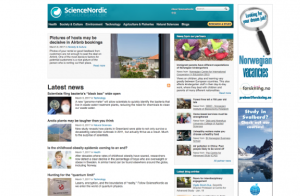
The team behind ScienceNordic describes this online publication as "the trusted English-language source for science from Nordic countries." ScienceNordic is authored by Forskning.no and Videnskab.dk, science news organizations based out of Norway and Denmark, respectively. Visitors can browse this blog by a number of categories, including Health, Society and Cultures (where visitors will find stories addressing the intersections of science and society), and Technology, Within these categories, readers will find articles about recent research studies, health care innovations, technological developments, environmental news, and more. New articles are added almost daily. ScienceNordic will appeal to researchers and journalists who seek to stay informed about science developments around the globe, as well as anyone with an interest in science, health, and environmental news. [MMB]

TypeWolf
Educational Technology
Typography enthusiasts, including professional graphic designers and those of us with a general fondness for font design, will enjoy TypeWolf, a website about "what's trending in type." Authored by professional designer Jeremiah Shoaf (whose clients include the Discovery Channel, Animal Planet, and The Washington Post to name just a few), TypeWolf features a number of interesting resources and articles. Anyone currently engaged in design projects, such as creating a website, flyer, or infographic, may want to start by checking out Font Recommendations & Lists. Here, visitors can explore Shoaf's top ten fonts that are underused, check out possible alternatives for the ubiquitous Helvetica, and learn where to find free fonts. Meanwhile, Web Fonts in the Wild features a new website (and font) each day, allowing designers to visualize how fonts shape the aesthetic character of different websites. Those interested in reading Shoaf's musings about new developments in the world of typography can do so via his Blog. Finally, the Guides & Resources section offers links to a variety of outside resources including online books, blogs, and more. [MMB]

YouTube: Reactions
Science
What is catnip, and why do cats react to it? What is the best way to clean and care for a cast iron skillet? How does shampoo work? Why do onions make you cry? From the American Chemical Society (ACS) comes Reactions, a series of videos that address the kind of chemistry questions that you've probably found yourself pondering about at some point. Each video is approximately three to five minutes and length and presents a series of engaging video clips and diagrams. Through these videos, viewers will learn about an array of chemical compounds that affect their everyday lives, perhaps in ways they did not realize. These videos make for enjoyable browsing for the generally curious and provide some helpful life hacks to boot. [MMB]

Literary Hub
Language Arts
Literary Hub is an online magazine that strives to be "a single, trusted, daily source for all the news, ideas and richness of contemporary literary life." To do so, Literary Hub partners with a wide variety of sources for literary news and reviews, including publishers, bookstores, and literary journals. Readers will find book reviews, author profiles, interviews, essays, book excerpts, and more. Those looking for a new read may want to start with Bookmarks, a feature that helpfully compiles critical reviews of new books from major publications. Readers can then see how these reviewers assessed the book (reviews are categorized as Rave, Positive, Mixed or Pan) and read these reviews in full. Meanwhile, readers can explore a number of original pieces in Features. As of this write up, recent pieces in Features include an essay by novelist and short story writer Jhumpa Lahiri and a profile of author Jami Attenberg. Those who want to stay informed about literary news may want to sign up for Lit Hub Daily, a regular round-up of literary news from Literary Hub and other publications and organizations. [MMB]

The Travel Letters of Mrs. Kindersley
Social studies
Jemima Kindersley (nee Wicksteed) was born in Norwich, England in 1741. In 1764, after her marriage to Nathaniel Kindersley, the young couple embarked on a series of global travels. Destinations included Salvador, Brazil, the Cape of Good Hope (in modern-day South Africa) and Calcutta, India. In 1777, almost a decade after her return to England, Kindersley published Letters from the Island of Teneriffe, Brazil, the Cape of Good Hope, and the East Indies. The book was one of the first travelogues to be penned by a woman. On this website, visitors can browse over 60 transcribed letters penned by Kindersley during her travels. These letters are tagged by a number of terms to aid in browsing, and are perhaps best explored via interactive map, where letters have been arranged by geographic location. Visitors can also browse especially memorable quotes by topic in the Find Quotes By Map section. [MMB]

Poetry and Prayer: Islamic Manuscripts from the Walters Art Museum
Arts
First open to the public in 1909 in Baltimore, the Walters Museum began as the collection of William Thompson Walters and his son, Henry. Bequeathed to the city of Baltimore in 1931, the collection has grown to include 35,000 artifacts from "ancient Egyptian mummy masks and medieval armor to 19th-century French impressionism and turn-of-the-century art deco." The Walters collection also includes significant Islamic manuscripts. In 2008, the museum received an NEH grant to catalog and digitize 236 of these illuminated manuscripts dating from the 9th to the 19th centuries containing 53,000 folios (2-page spreads). This exhibition is based on the NEH grant work, and permits visitors to view the manuscripts in an online, page-turner format. For example, W.658 is Kitab-i Bahriye (Book of the Sea), with a Map of the Bay of Salonica, and includes 240 maps and charts, while W.568 is a manuscript fragment of the Qur'an from the 12th century, written on Italian paper in a large Maghribi script. [DS]

Network Tools

Back to Top

Ghost Browser
Science
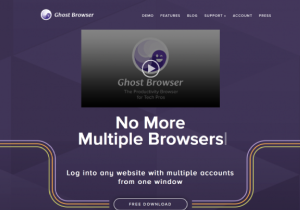
Do you have multiple social media accounts - perhaps a Facebook account for work as well as a personal one? Or do you manage multiple Twitter accounts as part of your job? If so, Ghost Browser may be for you. This free web browser allows users to be logged into multiple social media accounts simultaneously. Available for Mac and Windows computers, Ghost Browser allows users to open and save different accounts through a color-coded tab system. Users can also save these accounts as a project (e.g. "Twitter accounts") in order to open a series of accounts quickly and easily in the future. Ghost Browser also allows users to import bookmarks from existing web browsers and to import Google Chrome extensions. [MMB]

Pixabay
Arts
Finding the perfect image or video clip for a website, poster, or presentation can be a challenge. Pixabay is a helpful repository of images and videos available for use under the Creative Commons CC0 license. On this website, users can browse for images by a number of categories, including Education, Health/Medical, Computers/Communications, and Emotion. In addition to photos, this collection also includes Illustrations, Vector Graphics, and Videos. Pixabay is also available as an Android or iOS application. [MMB]

In the News

Back to Top
Ancient Dental Plaque Provides a Glimpse into Early Medicine and the Original Paleolithic Diet
NOVA: A Neanderthal Burial
http://www.pbs.org/video/2324065933
The Paleo Diet, popularized by Loren Cordain in a 2002 book of the same title, purports to help people lose weight by encouraging them to imitate the diet of Paleolithic humans. How well does this diet actually resemble what our prehistoric ancestors ate? An international team of researchers, led by the University of Adelaide's Center for Ancient DNA, has recently uncovered new insights into that question through a surprising source: Neanderthal dental plaque. The team examined the plaque of five Neanderthals skulls, ranging in age from 42,000 to 50,000 years old, found at two different cave sites: Spy in Belgium and El Sidron in Spain. Microbiologist Laura Weyrich, the study's lead author, explained, "Dental plaque traps microorganisms that lived in the mouth and pathogens found in the respiratory and gastrointestinal tract, as well as bits of food stuck in the teeth - preserving the DNA for thousands of years." By sequencing and examining this DNA, the research team inferred that Neanderthal diets likely varied widely by region. While Spy Cave Neanderthals ate meat (likely from wild rhinos and sheep), those in El Sidron had a vegetarian diet consisting of pine nuts, mushrooms, and tree bark. In short, as Dr. Weyrich puts it, "The true paleo diet is eating whatever's out there in the environment." [MMB]
To learn more about this discovery, the first three links take readers to articles from The Atlantic, The Guardian, and Popular Archeology. These articles contain links to the original research paper, published in Nature earlier this week, for those interested in reading the original study in full. The fourth link takes readers to a long form feature by Jon Mooallem in The New York Times earlier this year. In this piece, Mooallem explores the history of research into the Neanderthal and how this early human ancestor came to be (inaccurately) maligned as "a slow-witted lout." The fifth link, a 2013 NOVA documentary about Neanderthal burial practices, offers further clues about the lifestyle and rituals of the Neanderthal. The final link takes visitors to an interactive Human Family Tree, courtesy the Smithsonian National Museum of Natural History. Here visitors can explore six million years of human evolution and learn more about major prehistoric ancestors, including Neanderthals.
The Scout Report (ISSN 1092-3861) is published every Friday of the year except for the last two Fridays of December by the Internet Scout Research Group, based in the University of Wisconsin-Madison's Department of Computer Sciences.

--
This message was sent to olderkirby@gmail.com by scout@scout.wisc.edu
To forward this message, DO NOT use the forward button in your email client. Instead, use the forward function of our newsletter system
To change your details and to choose which lists to be subscribed to, visit your personal preferences page
Or you can opt-out completely from all future mailings.